
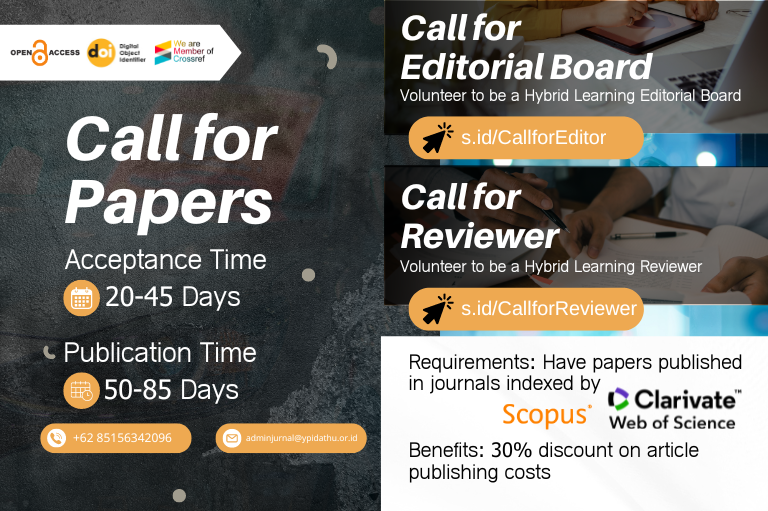
Journal Neosantara Hybrid Learning is dedicated to original, innovative, and critical studies on the integration of advanced technology in hybrid learning practices, with a particular emphasis on multiculturalism, social inclusion, and adaptive pedagogy. The journal publishes research examining how artificial intelligence, immersive technologies, gamification, and emerging digital tools reshape teaching and learning across formal, informal, and non-formal educational settings.
Journal Neosantara Hybrid Learning has published regular issues since 2023, initially at a frequency of approximately three issues a year. Effective from Volume 3, Issue 1 (2025), the journal changed its publication frequency to bimonthly, with issues released in February, April, June, August, October, and December.
The journal contributes to the development of both theory and practice in hybrid education. The editorial team welcomes academically robust empirical research, case studies, action research, theoretical discussions, and literature reviews that advance knowledge across the journal's scope — including inclusive educational technology, AI-driven personalization, digital ethics and privacy, social-emotional learning, and neuroeducation. All papers undergo double-blind peer review.
| Journal title | Journal Neosantara Hybrid Learning |
| Initials | JNHL |
| Abbreviation | J. Neosantara Hybrid Learning |
| Print ISSN | 2987-2316 |
| Online ISSN | 2986-979X |
| Frequency | Bimonthly | February, April, June, August, October, and December |
| DOI | prefix 10.70177/jnhl |
| Editor-in-chief | Ahmad Firdaus bin Mohd Noor, (Scopus ID : 58634700700), Universiti Teknologi MARA, Malaysia |
| Organized | Yayasan Adra Karima Hubbi |
| Citation Analysis | Scopus | Web of Science | Sinta | Dimensions | Google Scholar |
OAI Address
The Journal Neosantara Hybrid Learning is published by Yayasan Adra Karima Hubbi, West Sumatra, Indonesia. has OAI address:
https://research.adra.ac.id/index.php/jnhl/oai
You have to make sure that your paper is prepared using the JNHL paper Template has been carefully proofread and polished and conformed to the author guidelines.
- Already have a username/password for Journal Neosantara Hybrid Learning? GO TO LOGIN
- Need a username/password? GO TO REGISTRATION
Current Issue
Vol. 4 No. 3 (2026)


Published: 2026-06-09
Articles
DIGITAL WELLBEING IN HYBRID LEARNING ENVIRONMENTS: BALANCING ACADEMIC PERFORMANCE AND MENTAL HEALTH
 Philippines, Philippines, Philippines,
  Indonesia
 ARTIFICIAL INTELLIGENCE–DRIVEN PERSONALIZATION IN HYBRID LEARNING: OPPORTUNITIES, RISKS, AND PEDAGOGICAL IMPLICATIONS
Indonesia,  Japan, Japan
 BRAIN-BASED LEARNING STRATEGIES FOR PERSONALIZED HYBRID EDUCATION
 Brazil, Brazil, Indonesia